Hours, directions, entrances, and the best time to arrive
Home of Carlsberg visitor guide in Copenhagen
The Home of Carlsberg is the original Copenhagen brewery site where Carlsberg’s story is told through a self-guided exhibition, historic yard, and on-site beer tasting. It’s a manageable visit rather than an all-day one, but timing still matters because tickets are dated, entry closes at 4pm, and you’re assigned the next available slot on arrival. This guide covers timing, tickets, arrival, and what to prioritize once you’re inside.
Quick overview: Home of Carlsberg at a glance
If you want the short version before you book, this is what actually changes the visit.
- When to visit: Daily, 10am–6pm, with last entry at 4pm; 10am–11am is noticeably calmer than 1pm–3pm because dated tickets are converted to the next available slot when you arrive.
- Getting in: From 235 DKK for standard entry. Add-ons like cellar tours and guided tastings cost extra, and booking ahead matters most in summer afternoons and on weekends when later same-day slots fill first.
- How long to allow: 1–1.5 hours for most visitors. It stretches closer to 2–2.5 hours if you add a tasting, cellar tour, food, or time in the courtyard.
- What most people miss: The historic yard and stables reward more attention than most people give them, and the cellar add-on is the part that feels least like a standard museum visit.
- Is a guide worth it? For the main exhibition, no — the self-guided format works well — but the cellar tour adds value because the underground spaces are more atmospheric with context.
Jump to what you need
🕒 Where and when to go
🗓️ How much time do you need?
Visit lengths, suggested routes, and how to plan around your time
🎟️ Which ticket is right for you?
Compare all entry options, tours, and special experiences
🗺️ Getting around
How the exhibition and brewery yard are laid out and the route that makes most sense
🍺 What to see
Interactive exhibition, Elephant Gate, and the cellars
♿ Facilities and accessibility
Restrooms, dining, accessibility details, and family services
Where and when to go
How do you get to Home of Carlsberg?
Home of Carlsberg sits in Carlsberg City, west of central Copenhagen, within walking distance of Carlsberg station and easy reach of Vesterbro.
Gamle Carlsberg Vej 11, 1799 København V, Denmark
→ Open in Google Maps
- S-train: Carlsberg station → about 10 minutes on foot → the simplest rail option if you’re coming from central Copenhagen.
- Metro: Enghave Plads station (M3) → about 15 minutes on foot → easiest if you want to combine the visit with Vesterbro.
- Taxi / rideshare: Drop-off on Gamle Carlsberg Vej → direct access to the main visitor area and courtyard.
Full getting there guide
Which entrance should you use?
The setup is straightforward: there is one main visitor entrance, and the mistake most people make is arriving too late in the day because the venue stays open until 6pm but admission stops at 4pm.
- Main entrance: Located on Gamle Carlsberg Vej. Best for all ticket holders. Expect around 5–20 minutes of waiting during the 12 noon–3pm arrival window.
Full entrances guide
When is Home of Carlsberg open?
- Monday–Sunday: 10am–6pm
- Entry window: Arrive any time between 10am and 4pm on your chosen date
- Last entry: 4pm
When is it busiest? Summer afternoons, weekends, and post-lunch arrival windows feel busiest because same-day visitors stack up for the next available slot and the courtyard gets fuller.
When should you actually go? Arrive close to opening if you can, because you’ll usually get in faster and the exhibition is easier to enjoy before the tasting and restaurant areas fill up.
How much time do you need?
Which Home of Carlsberg ticket is best for you
| Ticket type | What's included | Best for | Price range |
|---|---|---|---|
Home of Carlsberg Experience Entry Ticket | Entry to Home of Carlsberg Experience + one beer or soft drink | A self-paced visit where you want the core exhibition, the historic brewery setting, and one included drink without committing to extra add-ons | From 235 DKK |
How do you get around Home of Carlsberg?
Layout and suggested route
The Home of Carlsberg is laid out like a compact museum visit with a historic outdoor setting around it, so it’s easy to self-navigate if you don’t rush past the courtyard spaces.
- Main exhibition: Multimedia storytelling, brewing history, and artifacts from 1847 to today → budget 45–60 minutes.
- Historic courtyard: Original brewery atmosphere, iconic structures, and space to slow down after the exhibition → budget 10–15 minutes.
- Stables and heritage features: The old brewery character is strongest here, especially if you want the site to feel more than brand history → budget 10 minutes.
- Cellars add-on: Atmospheric underground spaces on a guided route, not part of the standard core visit → budget about 30 minutes.
- Bar and shop: Best saved for the end so your included drink feels like part of the visit, not an interruption → budget 15–30 minutes.
Suggested route: Start with the main exhibition while you’re freshest, step outside to the courtyard and stables once the story has context, and save your included drink for the end. Most visitors do the reverse and end up giving the historic site itself less attention than it deserves.
Maps and navigation tools
- Map: On-site visitor guidance covers the main exhibition and courtyard route → pick it up when you enter.
- Signage: Good enough for the standard route, but the heritage details outside the main exhibition are easier to miss if you move too quickly.
- Audio guide / app: The self-guided exhibition uses strong in-gallery media and English-language interpretation, so most visitors won’t need anything extra.
💡 Pro tip: Don’t redeem your included drink at the start unless you’re only here briefly — the route makes more sense when you treat the bar or courtyard stop as the finish line.
Get the Home of Carlsberg map / audio guide
Where are the masterpieces inside Home of Carlsberg?

1/6
The interactive exhibition
Era: 1847 to today
This is the heart of the visit: a large, multimedia exhibition that moves from J.C. Jacobsen’s first brew to the science, branding, and scale behind modern Carlsberg. It works best when you let the story build instead of skimming for beer facts alone. Most visitors rush the sections on brewing innovation, but that’s where the site feels least like a brand museum and most like industrial history.
Where to find it: Inside the main exhibition space immediately beyond the visitor entrance.
The historic brewery courtyard
Type: Original brewery setting
The courtyard is what turns the visit from a museum into a place-based experience. You’re standing in the original brewery complex, surrounded by preserved industrial architecture that gives the Carlsberg story real weight. Most people pass through quickly on their way to the bar, but it’s worth slowing down here because the setting explains why this site still matters in Copenhagen.
Where to find it: Outside the main exhibition halls, at the center of the historic brewery complex.
The Elephant Gate
Type: Landmark architecture
This is one of the most recognizable Carlsberg landmarks and one of the strongest visual reminders that the site was built as much for legacy as for production. It’s easy to treat as a photo stop and move on, but the scale and detail are part of what makes the old brewery grounds memorable. Many visitors see it only in passing instead of tying it into the broader history of the Carlsberg family site.
Where to find it: In the historic brewery grounds, visible from the courtyard approach.
The old stables
Type: Heritage feature
The stables ground the visit in the working life of the old brewery in a way the digital exhibition can’t. They show how the site functioned as a real industrial complex, not just a brand birthplace, and they’re one of the best places to feel the original atmosphere. Most people focus on the beer story and underplay these practical spaces, which is a miss.
Where to find it: Along the heritage route in the old brewery yard.
The underground cellars
Type: Guided add-on experience
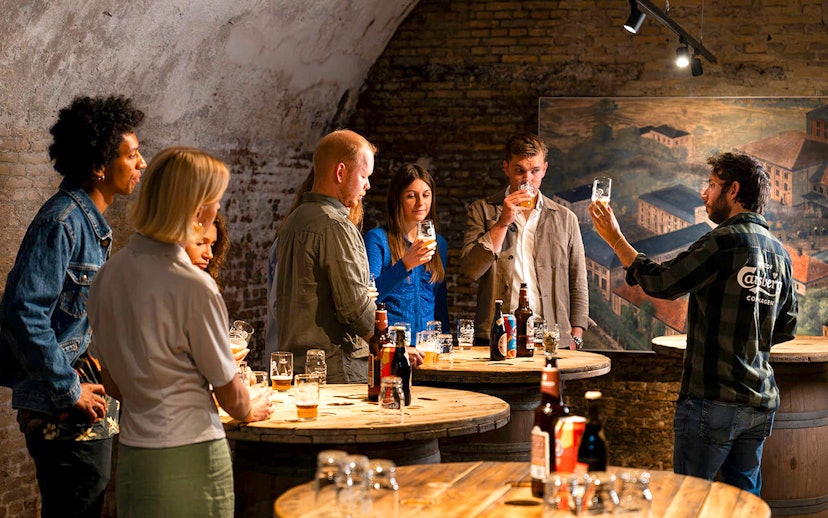
If you add the cellar tour, this is the most atmospheric part of the site. The old storage tunnels give you a far stronger sense of historic brewing conditions than the main exhibition alone, and the guided format helps because the spaces matter more with explanation. What many visitors miss is that this isn’t part of the basic route — you need to book it as an add-on.
Where to find it: Access is via the guided cellar tour meeting point within the Home of Carlsberg site.
The bottle and memorabilia displays
Type: Collection highlight
These displays are less dramatic than the courtyard or cellars, but they’re one of the clearest ways to see how Carlsberg built a global identity over time. The old packaging, labels, and bottles show the brand’s evolution in a way that feels more human and specific than the big-screen storytelling. They’re easy to rush past because they sit inside a broader narrative route rather than as a standalone room.
Where to find it: Within the main exhibition sequence, alongside the history and brand-story sections.
Facilities and accessibility
- 🎟️ Included drink: Every standard visit includes one beer or soft drink, which you can redeem on-site after exploring.
- 🍽️ Carlsberg Bar and Faust restaurant: You can stay for a drink or meal in the restored brewery setting, which makes the site work well as a longer stop rather than a quick museum run.
- 🛍️ Gift shop / merchandise: A large brand store sells Carlsberg merchandise and memorabilia, and it’s easiest to browse at the end of your visit.
- 🚻 Restrooms: Restrooms are available on-site, so you don’t need to leave the complex during a standard visit.
- 🪑 Seating / rest areas: The courtyard, bar, and dining areas are the main places to sit down and slow the visit down.
- 🅿️ Parking: There is no dedicated visitor lot, but public parking garages in Carlsberg City are the practical option if you’re driving.
- ♿ Mobility: Home of Carlsberg is not wheelchair accessible, so this is not a good fit if you need a fully step-free route.
- 👁️ Visual impairments: Service dogs are welcome, and the experience mixes large-format media with object displays rather than relying on a single format throughout.
- 🧠 Cognitive and sensory needs: The multimedia exhibition can feel louder and more stimulating around midday, so the opening hour is the easier low-crowd window.
- 👨👩👧 Families and strollers: Children are welcome with an adult, but the historic setting is less straightforward than a fully modern museum if you’re moving through with a large stroller.
This works best for older children and teens who enjoy interactive exhibits, stories, and unusual spaces more than hands-on play.
- 🕐 Time: Around 60 minutes is realistic with children before the history-heavy sections start to drag, so prioritize the exhibition’s most interactive parts and the courtyard.
- 🏠 Facilities: Soft drinks are available instead of beer, and the self-paced format makes it easier to take breaks than a fixed guided tour.
- 💡 Engagement: Frame the visit around how beer was made, stored, moved, and branded rather than around tasting, and the site becomes more interesting for younger visitors.
- 🎒 Logistics: Arrive early in the day, keep the visit compact, and don’t plan it as a late-afternoon stop because last entry is 4pm.
- 📍 After your visit: Frederiksberg Gardens is a good next stop if your group needs open space after an indoor museum-style visit.
Rules and restrictions
What you need to know before you go
- Entry requirement: Your ticket is dated, not timed, and you can arrive any time between 10am and 4pm for the next available entry slot.
- Age policy: Guests under the age of 18 years must be accompanied by an adult.
- Late-arrival reality: The venue stays open until 6pm, but arriving late cuts your visit short because entry stops 2 hours before closing.
Not allowed
- 🚫 Pets: Pets are not allowed inside the venue.
- 🐾 Service animals: Service dogs are welcome.
- 🍽️ Outside visit planning: Don’t assume you can treat this like an open-ended evening stop, because the admission window closes well before the venue does.
Photography
Photography is best treated as allowed in the general visitor areas unless on-site signage says otherwise. If you’re joining an add-on experience such as the cellar tour, follow staff instructions in those spaces, and don’t assume rules are identical everywhere. As with most indoor heritage attractions, flash gear, tripods, and anything that slows visitor flow are the most likely things to cause problems.
Good to know
- Included drink: Standard entry covers the exhibition and one beer or soft drink, but cellar tours and guided tastings are separate add-ons.
- Best timing move: If you want both the exhibition and time to eat or drink on-site, arrive well before 3pm rather than trying to squeeze everything into the last part of the day.
Practical tips
- Booking and arrival: Book ahead for summer and weekend visits, then aim to arrive by 11am if you want the smoothest entry because dated tickets are assigned to the next available slot only after you show up.
- Pacing: The core exhibition takes about 60–90 minutes, so save extra time only if you’re adding the cellar tour, a tasting session, or a meal in the courtyard.
- Crowd management: The best window is usually the first hour after opening, because later arrivals bunch together and the self-guided exhibition feels busier once the lunch crowd starts filtering in.
- What to bring or leave behind: Bring ID if you plan to redeem the included alcoholic drink, and don’t count on turning up at 4:30pm just because the venue closes at 6pm.
- Food and drink: The included drink works best at the end of the visit, not the start, and the bar or restaurant makes more sense as a post-visit stop than a mid-route break.
- Visit planning: If the underground cellars matter to you more than the main exhibition, book that add-on before arrival because it’s the part people most often realize too late they wanted.
What else is worth visiting nearby?
Commonly paired: Copenhagen Zoo
Distance: 1.8 km — about 25 minutes on foot or 10 minutes by bus
Why people combine them: It makes sense as a same-side-of-the-city pairing if you want one culture-and-history stop and one broader family attraction in the same day.
Book / Learn more
Commonly paired: Frederiksberg Gardens
Distance: 1.6 km — about 20 minutes on foot
Why people combine them: It’s the easiest reset after an indoor visit, and the green space works especially well if you want a slower afternoon after the exhibition and beer stop.
Book / Learn more
Also nearby
Cisternerne
Distance: 1.7 km — about 22 minutes on foot
Worth knowing: If you liked the moodiest parts of Home of Carlsberg, this underground art space is the strongest atmospheric follow-up nearby.
Søndermarken
Distance: 1.5 km — about 18 minutes on foot
Worth knowing: This park is the easy add-on if you want fresh air, a quieter pace, or somewhere to walk before heading back into central Copenhagen.
Eat, shop and stay near Home of Carlsberg
- On-site: Carlsberg Bar and Faust restaurant serve drinks and full meals in the restored brewery setting, and they’re worth it if you want to stay immersed rather than move on immediately.
- Madklubben Vesterbro (about 20 minutes on foot, Vesterbrogade 62, 1620 København V): Reliable Danish brasserie-style food at a mid-range price point, good for a relaxed post-visit meal.
- Mad & Kaffe (about 18 minutes on foot, Sønder Boulevard 68, 1720 København V): A strong brunch or light lunch stop if you’re visiting earlier in the day and want something casual before heading in.
- Restaurant Gorilla (about 25 minutes by foot or a short transit hop, Flæsketorvet 63, 1711 København V): Better for a longer dinner than a quick bite, and the setting works well if you’re continuing into Vesterbro afterward.
- 💡 Pro tip: If you want the included drink and a proper meal, do the exhibition first and eat afterward — stopping too early can make a 90-minute visit stretch awkwardly.
- Home of Carlsberg Brand Store: The obvious buy is branded glassware or brewery memorabilia, and it’s right on-site so you don’t need to make a separate detour.
- Fisketorvet Copenhagen Mall: Useful if you need practical shopping rather than souvenirs, and it’s an easy add-on by S-train or taxi after your visit.
Yes, if you want a base that feels more local than postcard-central Copenhagen and still keeps you well connected. Carlsberg City and nearby Vesterbro work especially well for food-focused stays, shorter transit rides, and evenings that don’t depend on being in the old center. If your trip is very short and you want to walk to the biggest landmarks, central Copenhagen is still easier.
- Price point: The area leans mid-range to upscale, with better value once you move a little farther into Vesterbro.
- Best for: Short city breaks where you want good restaurants, easy transit, and a neighborhood feel without staying in the busiest tourist core.
- Consider instead: Indre By suits first-time visitors who want the most central base, while Nørrebro is a better fit if food, bars, and a more local evening scene matter more than classic sightseeing access.
Frequently asked questions about visiting Home of Carlsberg
Most visits take 60–90 minutes. If you add a cellar tour, a guided tasting, or stay for food and drinks in the courtyard, plan closer to 2–2.5 hours. The visit is compact enough for a half-day, but it feels rushed if you arrive late and try to fit everything in before the 4pm last-entry cutoff.
Yes, booking ahead is the smarter move, especially for summer dates and weekends. Tickets are dated rather than timed, but you’re still assigned the next available slot when you arrive, so earlier booking gives you a better chance of getting the day you want without adjusting your plan at the last minute.
Arrive as early in the day as you reasonably can, even though the ticket is dated rather than timed. Entry works on the next available slot once you check in, so a 10am–11am arrival is usually smoother than showing up after lunch. Don’t treat 4pm like a suggested time — it’s the cutoff for getting in at all.
A small day bag is the safest choice for this visit. The venue doesn’t position itself as a place for a long luggage-heavy stop, and the route is easier when you’re traveling light through exhibition areas and historic spaces. If you’re arriving straight from the airport or train with large bags, sort storage elsewhere before you come.
Yes, casual photography is generally fine for most visitors. The part that matters is following any local signs or staff instructions in specific areas, especially on add-on experiences such as the cellar tour. If you’re carrying bulky gear, don’t assume tripods or flash setups will be treated the same way as a phone or small camera.
Yes, the self-guided format works well for small groups and casual shared visits. It’s easy to move at your own pace through the main exhibition, then regroup for a drink afterward. If your group wants the cellars or a structured tasting, book those extras in advance rather than trying to organize them on the spot.
Yes, but it works best for older children and teens rather than very young kids. The exhibition is interactive and visual, and under-18s can swap the included drink for a soft drink, but the core experience is still history- and brand-focused. Children under 18 must be accompanied by an adult throughout the visit.
No, Home of Carlsberg is not wheelchair accessible. That makes it a difficult choice if you need a fully step-free route through the full experience. If accessibility is a deciding factor for your Copenhagen plans, this is one attraction where it’s better to know the limitation in advance than hope the historic setting has modern access throughout.
Yes, food is available on-site and nearby. The Carlsberg Bar and Faust restaurant let you stay within the brewery setting after your visit, and Vesterbro has plenty of stronger sit-down options if you’d rather eat elsewhere. If you’re visiting late, remember that last entry is 4pm, so don’t build your whole afternoon around arriving after that.
A standard ticket includes entry to the Home of Carlsberg Experience and one beer or soft drink. It covers the main self-guided exhibition and the historic brewery setting, but it does not automatically include extra experiences such as the underground cellar tour or guided tasting sessions. Those need to be added separately if they matter to your visit.
Yes, you can arrive anytime between 10am and 4pm on the date printed on your ticket. The key detail is that you won’t walk straight into a guaranteed pre-booked timeslot — you’ll be assigned the next available entry when you arrive. That makes earlier arrival much more practical than treating it like an open-ended evening ticket.